


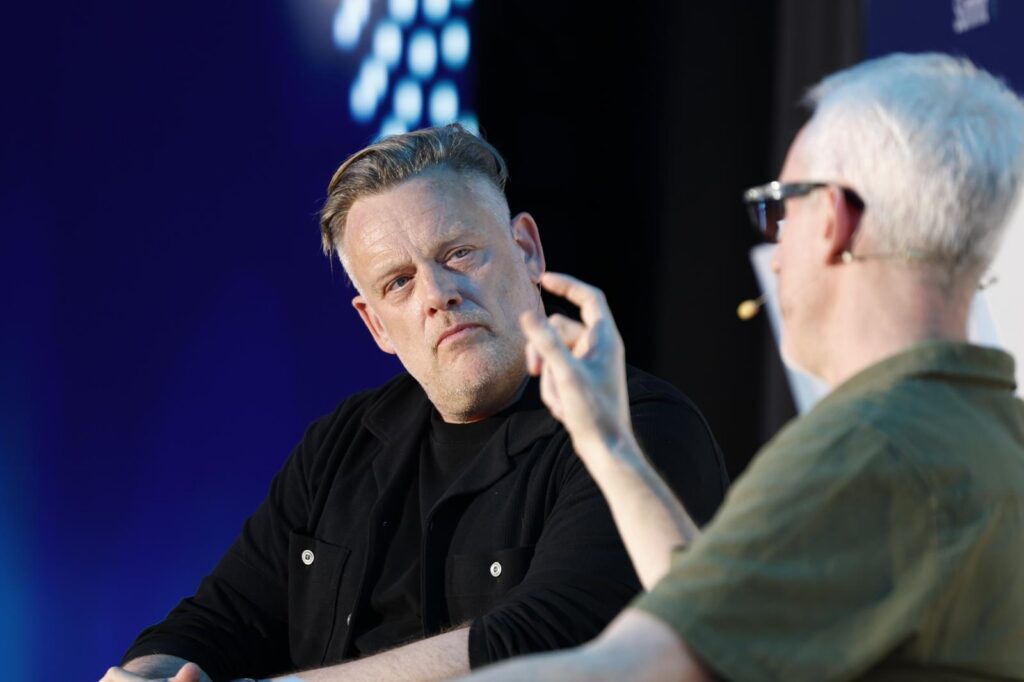
Pictured: Andrew Melchior, CTO of Massive Attack.
Day one at the RDS saw debates on AI-driven leadership prediction, social media regulation, biotech innovation and platform accountability, as speakers examined how rapidly evolving technologies are reshaping work, health and society.
By Emma Montalbani and Héloïse Chaudot
The air is buzzing with energy today at the RDS in Dublin, as the Dublin Tech Summit kicks off its milestone tenth edition. The annual gathering has long served as a vital connecting point for founders, investors, scaling organisations, and global tech leaders to discuss the latest trends shaping our digital future.
As Oisin Lunny, award-winning marketer and event MC, said to the audience before welcoming the first panellists on the main stage, “You are in possibly the most exciting room in Europe right now. We have such an incredible lineup of speakers for you, of experts, of people who are really pushing the boundaries in many fields.”
Against this backdrop, the next two days promise to prove him right.
Can Data Spot a Leader Before You Can – Eric Mosley, founder & CEO of Workhuman
The first session of the Tech Summit featured Eric Mosley and was hosted by Charlie Taylor, Technology & Innovation Editor, The Business Post.
Using more than one billion workplace recognition moments, the company’s AI model analyses patterns in employee behaviour, peer feedback and leadership trust to predict leadership potential, while also identifying employee disengagement and “talent leakage” before key staff leave organisations, allowing companies to address management, culture and retention issues earlier.
Importantly, Mosley warned that many companies are contributing to employee anxiety by overstating AI’s capabilities to justify layoffs, describing the trend as “AI washing”. However, he argued AI should be seen as a tool to enhance productivity rather than replace people.
He concluded that while AI will become widely available across industries, the real competitive advantage will still come from motivated employees, strong workplace culture and effective leadership.
Sarah Wynn-Williams – A conversation
Author and former Facebook public policy director Sarah Wynn-Williams warned that governments and technology companies are only beginning to confront the societal risks posed by social media and artificial intelligence.
Speaking on stage, Wynn-Williams compared growing concerns around children’s use of social media to the early stages of the tobacco industry reckoning, while noting that many Silicon Valley executives restrict their own children’s access to technology.
Building on this, the discussion turned to AI, where she warned that competition between companies and nations, particularly the US and China, is accelerating development faster than regulation and public debate can keep pace. She also raised concerns about AI’s use in military systems and autonomous weapons, arguing that governments, industry leaders and the public must play a greater role in shaping AI policy.
Doomscolled: Music in the Age of Endless Trash – Sigurdur Arnason, Co-founder & CEO of Overtune, and Paul Hourican, Head of Creative Industries at Namier Capital Partners
During the “Doomscolled: Music in the Age of Endless Trash” panel with Sigurdur Arnason and Paul Hourican, hosted by music journalist Eamonn Forde, the discussion quickly moved beyond the easy panic around “AI slop” and into a broader debate about creativity, platforms, and the economics of attention.
The panellists argued that generative AI is less a sudden rupture than the latest chapter in a long history of technological disruption in music, from Napster to streaming to TikTok. Yet the conversation repeatedly returned to the idea that the real problem may not be AI alone, but the social media ecosystems already conditioning audiences to consume culture through endless scrolling and instant gratification.
Hourican remarked that “Discovery isn’t the problem anymore […] there’s too much to discover,” capturing the overwhelming reality of today’s digital culture.
By the end of the session, the panellists framed generative AI less as an isolated threat and more as an accelerant for deeper tensions already reshaping music, creativity, and online life.
UpScrolled: Can Social Media Exist Without Manipulation? – Issam Hijazi, Founder & CEO of Upscrolled
In a parallel session, “UpScrolled: Can Social Media Exist Without Manipulation?” explored whether platforms can be rebuilt around ethics rather than engagement-driven algorithms.
Founder Issam Hijazi described the platform as an attempt to create a space where users can “have full control in terms of who you want to follow, who you want to see on the platform,” without feeds designed to maximise addiction or outrage.
Throughout the discussion, Hijazi repeatedly framed the project as a response to what he sees as increasing censorship and surveillance on mainstream social platforms. “There’s a global awakening of some sort happening everywhere,” he said. “Users started to look for ethical choices or alternatives; other platforms are designed systematically with addiction loops.”
He positioned UpScrolled as a response to concerns around surveillance, selective censorship, and the mental health effects of algorithmic feeds, while also stressing that moderation decisions should still involve people rather than AI alone.
“You always have to have a human in the loop,” he said. The conversation also highlighted Europe’s growing push for alternatives to dominant US tech companies, with Izan confirming that the company recently moved its headquarters to the Netherlands.
Other sessions from Day 1
Elsewhere, David Hartwig discussed how Ireland could play a stronger role in healthtech as biotech and AI converge.
He highlighted Airstead’s work on RNA-based therapies for neurodegenerative diseases like Alzheimer’s, alongside “brain shuttle” delivery systems designed to help drugs cross the blood-brain barrier. Hartwig emphasised that earlier intervention is critical, as most treatments arrive too late in disease progression.
He also noted that biotech is becoming faster and more AI-driven, but argued Ireland’s strength in pharma manufacturing has not yet translated into a strong early-stage biotech ecosystem, calling for more investment in R&D and startups.
In another session, Ciarán Murray discussed how reputation-based systems and crowd forecasting could help counter online disinformation. He argued that rewarding accuracy over time could improve information quality online, stating: “It’s all about moving the needle closer and closer to the truth,” and emphasised the growing importance of human verification in the AI era.
What to expect tomorrow
The second day of the Dublin Tech Summit will host another series of fireside chats and exhibitors in the RDS, Dublin, with speakers set to explore topics including artificial intelligence, cybersecurity, digital transformation and the future of work. Industry leaders, policymakers and innovators will continue discussions on the opportunities and challenges facing the global technology sector.