


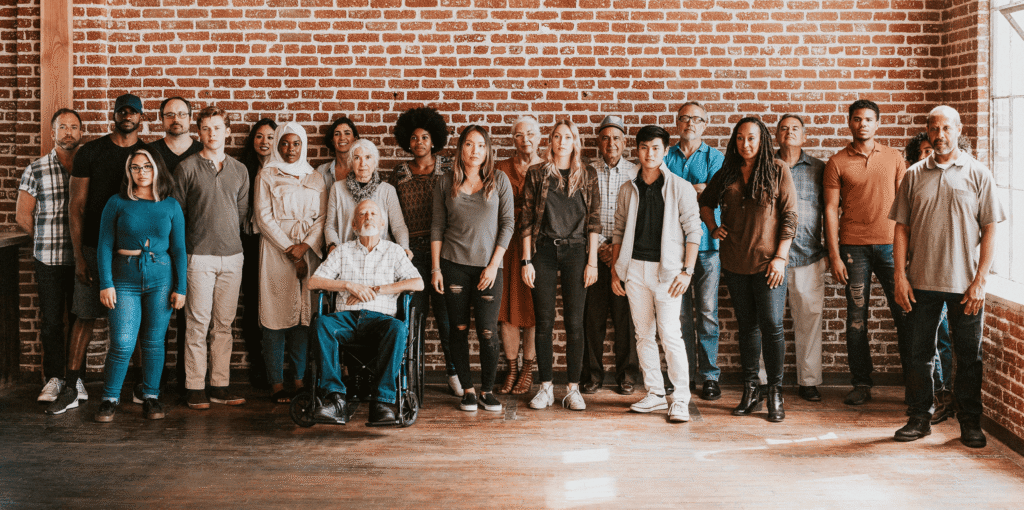
The Open Doors Initiative was founded to create pathways to education, employment, and entrepreneurship for people facing barriers. Here, Jeanne McDonagh, CEO, charts its progress.
Note: This piece was originally published in Business & Finance annual magazine 2025/26, vol. 62, available to read, with compliments, here.
By Jeanne McDonagh
The Open Doors Initiative began with a single person. Madeeha, a young refugee, came looking for a mentor, and I met her. This began a journey through helping her leave Direct Provision, find a home, get work, assist her through a cancer journey, help with reunification with her husband, and finally led to two miracle children and a promotion. She is now a manager and thriving in her life here.
She was the first Open Doors participant and led the way for over 130,000 people who have followed, through our work and that of our corporate partners.
It made me realise that business can be about something profoundly human: supporting people’s hopes and ambitions to help them build a new life. In the Open Doors Initiative, we identify and address cultural and structural barriers to opportunity and help people realise their ambitions. With humanity.
At the heart of what we do is equity—creating real opportunities for people who are often excluded. We create pathways to education, employment, and entrepreneurship for those who need it most: people with disabilities, members of the LGBTQ+ community, Traveller and Roma, refugees and migrants, people with a criminal past and others who face barriers.
They have the ambition, the skills and the talent and simply need someone to believe in them and help them navigate the world of work. We up-skill participants but also build capacity in partner organisations and their employees to welcome them.
What makes us different is that our team doesn’t just talk about inclusion – we live it. A third of us come from refugee backgrounds. A third, including myself, live with a disability. We are diverse in gender, in sexual orientation, in nationality, in outlook. Our research-based, lived experience shapes everything we do, and it is why the companies and participants we work with trust us. And they are amazing in all that they do, with purpose.
Why did I give up a great private sector position to found Open Doors?
There was a real need, it had a solution, and I scaled it. Since founding the Open Doors Initiative in 2018, we have helped, together with our partners, thousands of people begin careers and futures they thought were out of reach. We’ve built a network of over 130 organisations to make that possible and support the work. And we’ve done it as a fully remote, ethical social enterprise, driven by purpose.
We were born in adversity. The very day before lockdown, Open Doors went standalone. No training wheels and no way of leaving the house. I had to reinvent the company overnight. But there was an opportunity – suddenly I was speaking to CEOs and decision-makers online who would have been impossible to reach before – and despite restrictions and lay-offs, we grew. That resilience gives me hope: if we could rise in crisis, we can rise to any future challenge. The business community made that possible.
Why now?
We deal with some of the biggest issues of the day – migration, disability, fair chance, the pressing need for integration and empathy in society. The work of ODI could not be more urgent, as global migration impacts many countries. One in five people in Ireland today was born elsewhere. One in four in Dublin.
22% of our population identify as having a disability – yet only 35% are in work.
At the same time, Irish employers face the greatest skills shortage in 20 years. The solution is right in front of us: our participants have the skills, the ambition, and the drive – but face barriers of paperwork, skills recognition, language, or access. And fear of the unknown. How do I talk to this person? What if I say the wrong thing? What if I get into trouble? ODI helps dismantle those obstacles and sets people and companies up for success.
We are a not-for-profit company that reinvests all our surplus back into creating more opportunities. We train CEOs and their teams in inclusion, ensuring that diversity is not a bolt-on but a foundation – from the front door to the top floor. Two-thirds of our income comes from corporate partnerships that see the business value of inclusion. The remainder comes from the government, who trust us to deliver disability programmes and systemic change.
Diversity is not a nice-to-have. It is business doing business.
Inclusion is not only the right thing to do, but also the smart thing to do. It improves performance, strengthens reputation, leads to employee engagement and fuels long-term success.
Inclusion is hearts and smarts.
Why us?
With you, corporates with a positive ethos, we can really scale our impact. One of our programmes, mentorship, has been a cornerstone of our journey. It challenges, inspires, and lifts us all higher. We supported 258 participants last year alone and paired them with professional employees. We need your employees to grow this support, which inevitably leads to better outcomes for both parties. On this and our other programmes, which lead to life-changing outcomes.
With the backing of more companies, we can strengthen not just Open Doors but every participant we serve, because when we grow stronger, the impact on more lives rises tenfold. It’s a pyramid effect of support, opportunity and benefit.
We are ready to scale—to reach more people, to expand to other jurisdictions. To build an institute of research and training that allows businesses worldwide to learn with us and from us. Come be part of that journey.
Our vision is simple: a world where talent is valued, ambition cultivated, and no person is left behind. That’s what inclusion truly means. And that is the future we are building. Join us.
Those groups include migrants, refugees and asylum seekers, people with disabilities, youths from disadvantaged backgrounds and members of the travelling community, LGBTQI+ individuals, or people with criminal pasts or any intersectionality within those groups.