By Business & Finance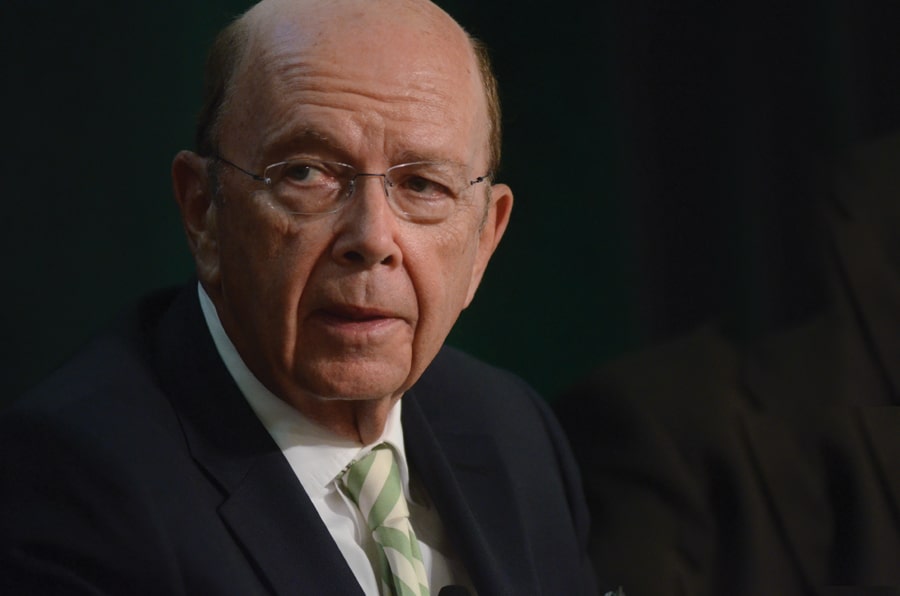
John Walsh sat down with Wilbur Ross, former US Secretary of Commerce, to discuss Ireland’s corporate tax future, US-Ireland economic relations, the trade policies of the Trump administration, and the potential impact of artificial intelligence on global markets.
Note: This piece was originally published in Business & Finance annual magazine 2025/26, vol. 62, available to read, with compliments, here.
By John Walsh
The current corporate tax bonanza enjoyed by the government will come to an end, but Ireland remains in a strong position to retain US multinational investment, according to a former US Secretary of Commerce.
“The tax advantages, such as US companies using Ireland to pay lower taxes on intellectual property assets, will come to an end. But Ireland has many natural advantages, and it will continue to grow strongly in the future,” Wilbur Ross said.
Irish corporate tax receipts grew from roughly €4.5bn in 2014 to over €28bn last year, largely on the back of the presence of US pharmaceutical companies.
On a number of occasions, Donald Trump has cited Ireland as a country that has taken advantage of the US.
“Every country that runs a favourable trade balance with the US of any consequence is going to have to find a new way to operate because as long as he [Trump] is in power, he is going to keep hammering away at the deficits,” Wilbur Ross told Business & Finance magazine on a recent trip to Dublin.
He said the Trump administration will address the loopholes that have enabled US multinationals to locate their intellectual property assets in Ireland to take advantage of the lower corporate tax regime.
Ross is familiar with the Irish economy. He made a high-profile investment in the Bank of Ireland in 2011, during the height of the financial crisis. It was a risky bet that paid off handsomely when he divested his shareholding in 2014.
And while the Trump administration will blunt the attractiveness of Ireland’s corporate tax regime, the country remains in a good position to prosper in the future, he said.
“Ireland has some natural advantages. It has a very well-educated English-speaking workforce, and it has built up considerable expertise in the areas of hi-tech and other value-added sectors. US companies will continue to operate in Europe, and it is logical that they retain Ireland as a regional headquarters.”
President Trump has adopted an increasingly aggressive ‘America First’ trade agenda since taking office at the start of this year. Tariffs have been a key policy tool to tackle the US trade imbalance.
Ross said that tariffs will remain in place as long as Trump is in office, but if they remain at the baseline rate of 15% for the EU, then they will only have a marginal impact on trade. He advised the Irish government to take every measure available to reduce the trade surplus with the US, such as buying US liquified natural gas (LNG) to ensure that relations with the Trump administration remain favourable.
He added that tariffs will have the desired effect of rebalancing the US economy.
“Firstly, they will bring in roughly €300bn if they remain at the baseline rates set out by Trump. This will help with the budget deficit, although on its own, it will not solve the problem.
“What is more important is that tariffs will lead to more companies investing in manufacturing in the US, which ultimately will lead to more and better-paying jobs.
“That leads to a situation where you get the benefits of the tariffs and the benefits of greater economic activity,” he said.
This interview with Mr Ross takes place on the same day the IMF released its forecast that US debt will reach 144% of GDP by 2035, overtaking Greece and Italy along the way.
Ross said the only way that the US will be able to solve its debt problem is through growth.
“It is clear that neither party [Republican and Democrat] is capable of cutting spending.” Spending pressures are likely to increase amid rising geopolitical uncertainty and the need for greater spending in defence. “At the moment, the US is spending more on interest payments on its debt than it is on defence.”
He said that it is a political certainty that there will be continued spending on social security in the US. “Nobody will do away with social security. Nobody will do away with the Medicaid programmes. The Trump administration will hopefully deal with some of the excesses and inefficiencies.”
He also cites an ageing population as another source of spending pressure. “In the US, roughly 10,000 people every day reach the age of 65. It is the fastest-growing part of the population, and they will have to be accommodated. So I don’t think real spending cuts are likely.”
He said that if the rate of growth is less than the budget deficit as a percentage of GDP, then the US debt burden will continue to grow. “If we don’t grow our way out of this, I don’t see any way of solving the debt problem.”
He cited Trump’s deregulatory agenda as an important element of the growth strategy, as it will incentivise businesses to grow and hire. On top of that, the Trump administration’s decision to lift restrictions on oil and gas exploration will ultimately lead to the US becoming a net exporter of fossil fuels, which will lead to much-needed export earnings and will also improve the US’s trade balance.
“I think all of these combined could lead to the level of growth needed in the US.”
There is a view that the US stock markets are in for a significant correction. Ross (87) has spent over sixty years on Wall Street as a highly successful corporate restructuring specialist.
He said that the group of companies known as the ‘magnificent seven’ – Alphabet, Amazon, Tesla, Meta, Nvidia, Microsoft and Apple – are responsible for much of the buoyancy in the markets. That is because of the very large bets they are making on artificial intelligence.
“If you take out those stocks, the rest of the market is not doing that much.
“If a couple of the magnificent seven stumble, then there will be a correction. However, a correction is inevitable, but the extent and timing of it depend on how these companies perform relative to the level of investment in artificial intelligence.”
The trillion-dollar question is whether artificial intelligence is transformative or whether it is a bubble similar to the dotcom bubble that crashed in 2001, which triggered a global economic slump.
“I think AI will be transformative, and I think it will lead to more and better jobs. It will transform the nature of work.”
However, markets may be reading too much into the transformative effects of AI. “People will not stop thinking for themselves.”
He compared the impact of AI with the development of GPS systems. The advances and the wider availability of GPS systems enabled people to navigate with much greater ease than the previous dependence on physical maps, he said.
“AI is just a souped-up version of GPS.” He said the danger with AI is that it is caught between two extremes. On the one hand, it doesn’t live up to the heightened expectations of the markets, and on the other hand, governments around the world will over-regulate, which will stymie its potential.
“These are the two extremes, but it remains to be seen whether they become the problem.”