By Business & Finance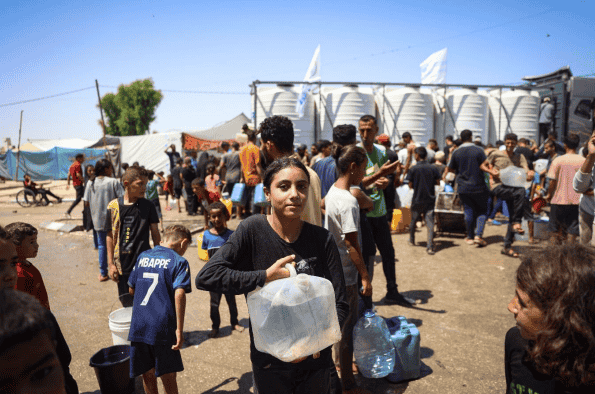
Pictured: Hiyam fetching water from a UNICEF-supported water tank in Deir al Balah, Gaza. Photograph: Eyad-El Baba/UNICEF.
Large investments and acceleration of efforts are needed if clean water and sanitation for all are to be realised by 2030.
Access to clean water and basic sanitation is a human right, yet 2.1 billion people – or one in four – lack access to safely managed drinking water and one in three people still lack access to safe sanitation.
UNICEF has supported water and sanitation efforts since its founding in 1946. The organisation’s earliest programmes focused on post‐war Europe, later expanding globally to help children access safe drinking water, adequate sanitation and improved hygiene. In recent years, as the impact of climate change becomes devastatingly evident and population growth reaches new levels, addressing these challenges has become exponentially more difficult.
UNICEF is entirely funded by voluntary contributions from governments, international organisations, foundations and private individuals. In 2024, the organisation spent more than €1.1 billion on its Water, Sanitation and Hygiene Programme (WASH). It ensured more than 33 million people in developing contexts were given access to safe water, provided 41 million people in humanitarian crises with water and granted 18 million people access to basic sanitation.
UNICEF water and sanitation expert Dara Johnston has worked in some of the world’s most difficult environments in his role, including South Sudan, Bangladesh and Gaza. While the organisation is responsible for staggering improvements in access to clean water and sanitation in more than 120 countries, he says the sector needs to see large investments and acceleration of efforts if the UN Sustainable Development Goals (SDGs) of clean water and sanitation for all by 2030 are to be realised.
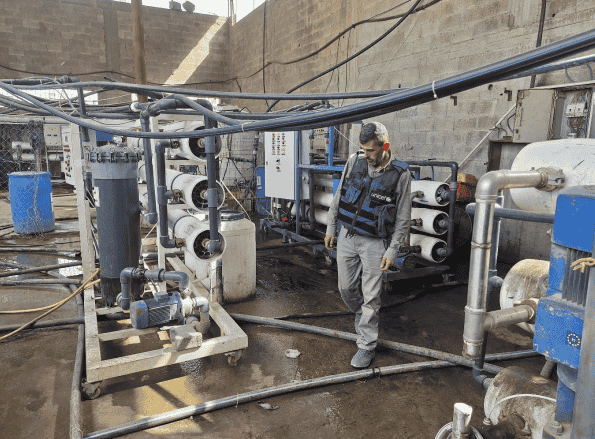
A UNICEF water and sanitation officer inspects a UNICEF-supported Palestinian Water Authority desalination plant in Gaza last October.
“Since the launch of the SDGs in 2015, the increase in access to safely managed water and sanitation has only just kept ahead of population growth, from 6.2 billion to 8.2 billion,” Johnston explains. UNICEF’s approach is to provide sustainable infrastructure that can be easily replicated, maximising the impact of its unique expertise in this area. For example, during his time in South Sudan, Johnston led a WASH programme which built five large water treatment plants for the capital city of Juba, as well as four large towns. In total, these five water systems have the capacity to provide safely managed water for more than 350,000 people.
“The last one completed, in the town of Bor, is a good example of UNICEF’s approach for sustainable infrastructure,” Johnston says. “The system replaced an older facility, which was very technologically challenging and expensive for the local authorities to maintain and operate. The new system, which was built on the bank of the Nile, is elevated to ensure it is not damaged by flooding, uses practical, simple technology and is entirely solar powered.” The project is multifaceted: in addition to the actual hardware, UNICEF provided capacity building and institutional strengthening for the local water utility to ensure proper management and operation.
“The long-term goal for UNICEF is to influence the government to build more similar systems, thereby increasing the number of people with sustained access to safely managed water and minimising the chances of cholera and other water-related diseases.” This is one of the interventions Johnston is most proud of, he says.
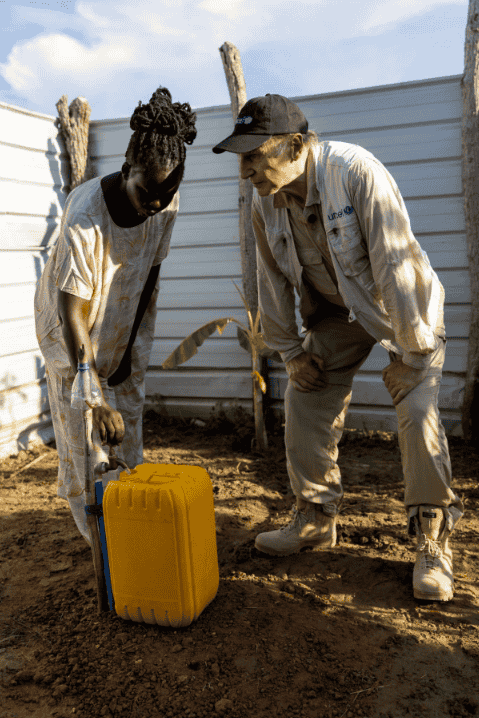
UNICEF goodwill ambassador Liam Neeson speaks with Theresa Achol (26) at a newly completed water treatment plant in Bor, South Sudan, last October.
In Bangladesh, the most densely populated country in the world, severe floods, cyclones and rising sea levels impact more than 20 million children every year. Even without these climate change-induced crises, Johnston notes that the water supply in the country has many challenges.
“The people in rural and peri-urban areas rely on shallow groundwater aquifers (natural water storage in rock formations), which are often polluted from poor sanitation or contain arsenic contaminants well above the levels permissible for safe human consumption,” he says.
“UNICEF works with the government in Bangladesh on a number of water and sanitation initiatives to alleviate these challenges, including systems to refill aquifers with rainwater, solar powered pumping of water from safe aquifers, affordable community-led arsenic identification methods, efficient handpump operation and maintenance systems and low-cost sanitation marketing.”
Bangladesh has made remarkable progress. Today, 98 per cent of the population has access to basic drinking water, up from 90 per cent in 2000. Open defecation has been almost eliminated, falling from 34 per cent in 1990 to under 1.5 per cent in 2019. “But with a population of 177 million,” Johnston says, “one and a half per cent is still significant – more than 2.6 million people.”
Sanitation has also improved dramatically: between 61 and 84.6 per cent of the population now uses basic sanitation facilities, up from just 25 per cent in 2000. Perhaps most importantly, the innovative systems recently implemented by UNICEF are now being scaled up by the Bangladeshi government.
Johnston most recently worked in Gaza, where years of inadequate water infrastructure collapsed into crisis as a result of the current conflict. UNICEF had just completed a 20 million litre desalination plant as the conflict began, he says, but it was a struggle to keep it operational over the past two years.
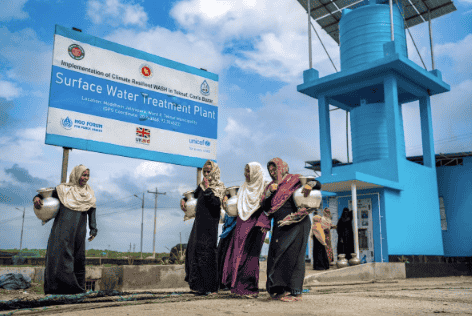
In Teknaf, Bangladesh, surface water treatment plants serve up to 6,000 people each, reducing dependence on groundwater and strengthening resilience against climate-induced water insecurity.
And while Gaza had a reasonable wastewater treatment and disposal system before the conflict, with almost all human waste being treated before being discharged into the sea, during the conflict, all treatment systems were non-functioning because of a lack of power and damage from bombardment. “Now, as we approach a period of possible reconstruction, an assessment of the damage shows that almost 85 per cent of the water and wastewater infrastructure is destroyed,” Johnston says.
UNICEF will work closely with the local authorities to develop the reconstruction plans, he says, while implementing a recovery plan to bridge the gap between now and when systems are restored. This is where the immense expertise of the UNICEF WASH experts comes into play, with small, decentralised water and wastewater systems that will allow for quick installation – crucial in the recovery period.
“In the long term, they minimise the risk of single facility breakdown impacting large numbers of people, which large systems inherently have,” he adds. To develop these technologies, UNICEF and the Palestinian Water Authority is in consultation with experts from three Irish universities, including Trinity College Dublin, University College Cork and Atlantic Technological University. Discussions are ongoing with Engineers Ireland, UNICEF Ireland and the Palestinian Water Authority to provide pro-bono technical support, initially for remote design support for the reconstruction process.
As the 2030 deadline of the SDGs approaches, Johnston is conscious that the successes of UNICEF’s WASH programmes need to be scaled up even further if clean water and sanitation are to be the preserve of all global citizens. Initiatives such as the CEO Water Mandate, which aims to advance corporate water stewardship around the world, offer a forum for companies to share good practices and forge partnerships to address urgent water challenges related to scarcity, quality, governance and access to water and sanitation.
“The answer lies with the private sector and public/private partnerships; and a better appreciation of the benefits of water and sanitation to society is needed,” he says. “Safely managed water and sanitation not only improves health and environmental conditions, it also has major impacts on socioeconomic conditions, leading to faster growth and more stable economies. This in turn has a significant impact on living conditions, migration and economic stability of developing countries.”
UNICEF invites companies to put children at the centre of their ESG strategy. Every child deserves access to clean water.
To find out more about how corporates and businesses can partner with UNICEF to deliver WASH initiatives all around the globe, go to unicef.ie/corporate or reach out directly to corporate@unicef.ie.
As seen in the Irish Times, 20/03/2026. Republished with permission and edited to conform with UNICEF style guidelines.