By Business & Finance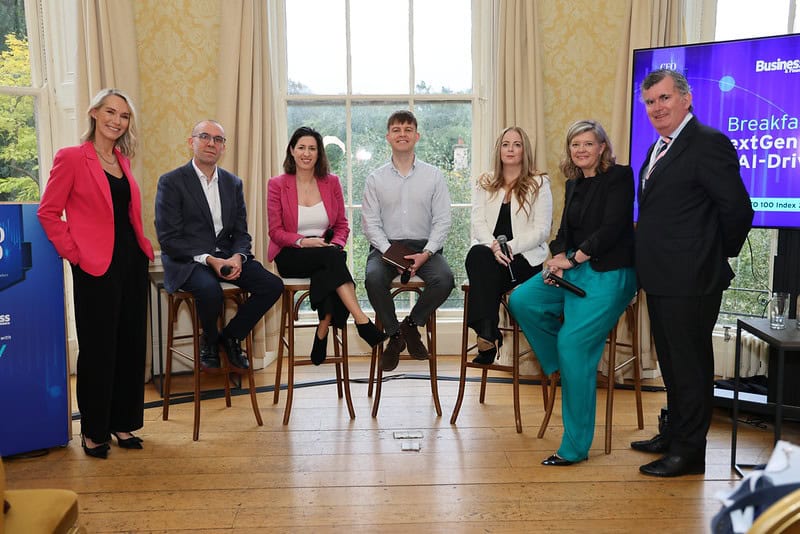
Pictured (L-R): Senator Dee Ryan, Brian Hanly (Brightbeam), Aine Nolan (Microsoft), Philip Watson (OpenAI), Patricia O’Neill (Chartered Accountants Ireland), Ciara Close (Sia), and Lawrence Vesey (Sia).
The CFO 100 Index 2025, in association with Sia, was launched today at a breakfast briefing in the Museum of Literature, Dublin. The event, which took the form of a panel, centred on NextGen Finance: The AI-Driven Future.
The CFO 100 Index 2025, in association with Sia, was launched today at a breakfast briefing in the Museum of Literature, Dublin.
Ireland as innovation hub
Senator Dee Ryan, Seanad Spokesperson on Further & Higher Education, Innovation, Research and Science, opened proceedings by congratulating the CFO 100 honourees.
Speaking as member of the Joint Oireachtas Committee on Artificial Intelligence, she outlined the committee’s aims: “The committee’s purpose is twofold – to ensure that Ireland is prepared legally and ethically and economically, but also to ensure that we’re able to see the opportunity that artificial intelligence presents for us as as an economy.”
She emphasised that AI is a general-purpose technology affecting every sector, outlining the significance of the EU AI Act as the first comprehensive regulatory framework for AI. She noted the contrasting approaches of the EU and the US, between “that US sensibility of freedom of speech and the European Union’s real value of privacy and all that we’ve done around GDPR.”
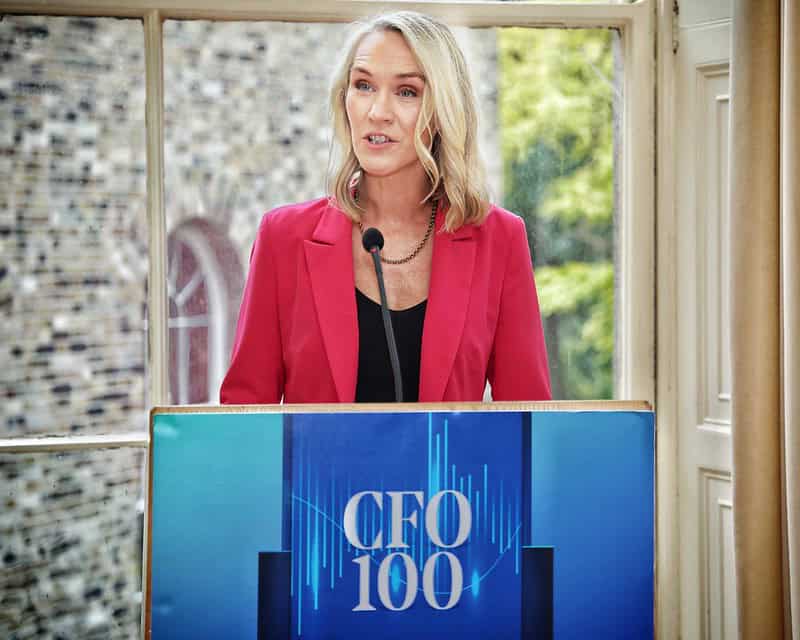
Pictured: Senator Dee Ryan
She said trust is a cornerstone of effective and responsible AI deployment.
She described Ireland’s role as particularly important because of its position as an open, digitally-driven economy, with a status as home to many global tech leaders and a young workforce.
“We have a strong technology ecosystem, a young, skilled workforce, and a track record of regulatory innovation,” she said.
To lead, Senator Ryan said, Ireland must invest in skills and support its own businesses to innovate, not just adopt to new technology.
Speaking about CFOs, she noted AI is transforming finance: The processes of automation, forecasting, and fraud detection have been augmented by its deployment.
Senator Ryan also stressed the need for accountability in AI-driven decision-making: “Transparency, explainability and accountability are crucial. A forecast generated by AI is only useful if the human decision.”
In closing, she said: “The EU AI Act gives us a framework, but our ambition as a country must give us momentum. We have to invest in skills, we have to support our indigenous businesses, and we have to strike a balance. If we do, Ireland can not only be a hub for AI but a beacon showing how a small nation can shape big technologies for common good.”
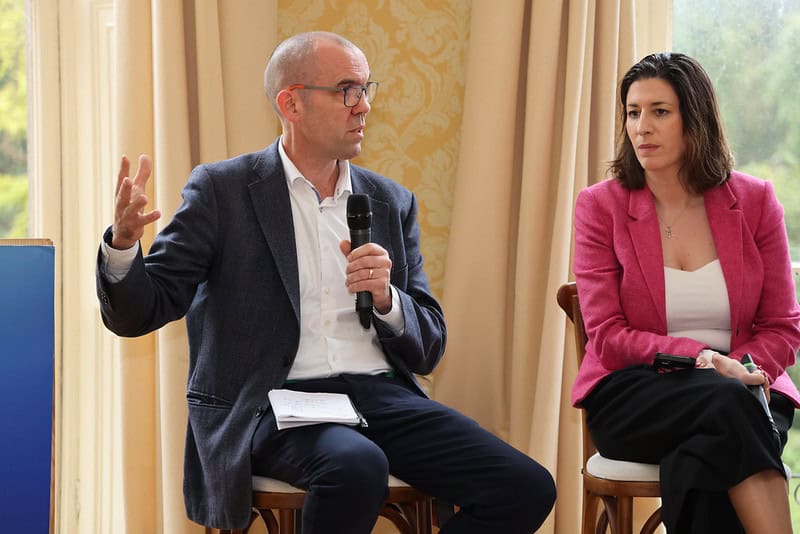
Pictured (L-R): Brian Hanly (Brightbeam), and Aine Nolan (Microsoft),
NextGen Finance: The AI-Driven Future
The launch of the CFO 100 Index 2025 was complemented by a panel discussion on NextGen Finance, a conversation about an AI-driven future. Moderated by Ciara Close of Sia, it featured Brian Hanly of Brightbeam, Aine Nolan of Microsoft, Patricia O’Neill of Chartered Accountants Ireland and Philip Watson of OpenAI.
Ciara Close opened with an interactive poll, a show of hands that revealed that attendees were at very different stages of their AI journey. Some were in the early stages of adoption, while others noted advanced company-wide use.
AI is transforming finance fundamentally, with leadership responsibilities expanding beyond managing people to leading teams that work alongside intelligent systems.
“It’s not just going to be about leading a team,” Close said. “It’s going to be about leading a team with machines.”

Aine Nolan spoke about the value of early wins: ““Early wins are absolutely critical to get that momentum,” she said.
She continued: “One of the quick wins I’ve implemented recently has been putting an agent in to get all of our forecasting done in the quarter … This has been an incredible time saver for us … Agents are a great way to do quick wins in any organisation … You can do a much broader scale one where you can have it maybe going through the CRM and actually looking for opportunities for sales, and then potentially writing an email for them.”
She also advised CFOs to frame AI adoption as a strategic enabler rather than just a cost-saving exercise to gain stronger board support.
Philip Watson said that finance lags behind other functions in AI adoption: “About 65% of teams are actively using AI. When you filter your spreadsheet down to only finance teams, that drops from 65% to 7%.”
His advice was to start small with a clear strategy, a “crawl, walk, run” approach. Begin with accessible tools to build literacy, then automate processes, and later develop custom solutions.
Brian Hanly discussed practical use cases. “In finance there there’s so many opportunities on the accounts payable, accounts receivable, commentary, those types of things. He said this offers clearer value and higher accuracy, particularly compared with older RPA tools.
When it comes to proof of concepts, “the concept has already been proven,” he said. Instead, “focus on how you’re going to do it.”
He continued: “It’s quite gold rush-y out there, so be sure the people you hire know what they’re doing.”
Trust and governance were recurring themes. Patricia O’Neill said: “In the past 17 years, I’ve been working with international accountancy bodies and throughout that time we’ve seen the rise of GDPR, the increasing need for accountants to be the guardians of data.”
She notes that role of the CFO is expected to deepen with AI: “There’s a lot of accountants coming to us at the moment looking for that level of education because they’re saying professional bodies have responsibility to ensure that know what their role is, and they know what their role is within that data piece, as they are trusted and their ethical leadership is trusted as well.”
Cultural change was identified as critical to success, with education and upskilling being crucial. According to O’Neill, while 85% of accountants are open to using AI, many lack confidence. Professional bodies are responding with training, toolkits and structured learning to ensure professionals keep pace.
READ MORE