By Business & Finance
As more companies invest in AI tools and are becoming an integral part of teams, CFOs are expected to ensure that AI delivers real business outcomes.
By Jose Fuentealba
Artificial intelligence and machine learning are no longer futuristic ideas or buzzwords; they are central to how organisations compete. Yet despite significant investment, many companies struggle to capture AI’s value: initiatives stall at the pilot stage, data remains fragmented, and financial returns are elusive. Increasingly, it is the CFO who is expected to ensure AI delivers measurable outcomes.
AI success is less about technology itself and more about three things firmly in the CFO’s remit: capital allocation, governance, and demonstrable value creation. Deciding where to invest is not straightforward. Should resources go towards enterprise-wide platforms, or should they go to business-unit pilots? How much budget should be allocated to experimentation versus scaling proven use cases? These are not purely IT questions but strategic investment calls through which C-suite members balance short-term pressures against the need to build long-term capabilities. The balancing act is delicate: focus too heavily on pilots, and scalability is absent; concentrate on big platforms, and the organisation risks stifling innovation.
Another challenge lies in fragmented ownership. CIOs often own the data, and operational leaders drive business decisions, while the CFO is left accountable for demonstrating ROI to shareholders. This misalignment leads to gaps such as failure to embed AI into decision-making, data that is curated but fails to connect to business priorities or pilots that work technically but lack a financial case. To close these gaps, CFOs must act as orchestrators, ensuring investment, data stewardship, and performance measures are aligned across functions.
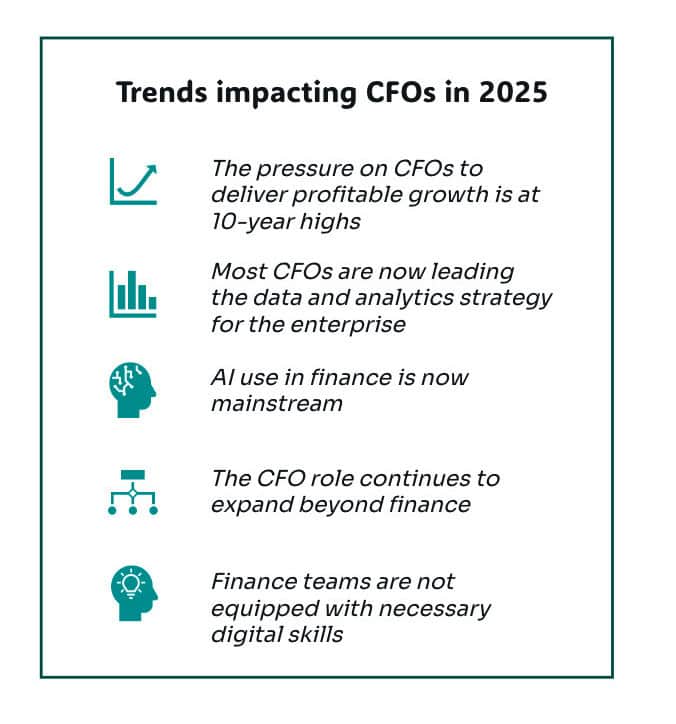
Gartner. (2024). Top 5 Strategic Priorities for Chief Financial Officers.
The CFO’s role in data governance is also pivotal. AI is only as strong as the data it runs on, yet many organisations wrestle with fragmented systems, inconsistent standards, and poor ownership. What has changed is that analytics performance is now directly tied to the CFO’s accountability, and to demonstrate AI’s impact on operations, CFOs need consistent, reliable, and relevant data across the enterprise. CFOs can then leverage their strengths in control, assurance, and reporting to lead on data governance and drive enterprise-wide alignment to ensure AI delivers real business outcomes.
For CFOs to succeed in this expanded role, three imperatives matter. Firstly, treat AI investment as a portfolio of bets, with clear criteria for when to scale and full transparency on risk and return. Secondly, establish cross-functional governance mechanisms that keep finance, technology, and operations aligned on priorities and responsibilities. And thirdly, treat data as a controlled asset, embedding a finance-led discipline so AI outcomes can be trusted, measured, and reported.
Sia brings experience in helping CFOs navigate this terrain. Through operating and governance model design, tried and tested methods to align dependencies across functions, and expertise in data management and lineage, Sia provides the structures needed for AI to deliver measurable impact.
AI has the potential to transform finance and the broader enterprise, but without strong CFO leadership in investment, alignment, and data governance, organisations risk overlooking critical opportunities. CFOs who embrace this expanded role will not just protect ROI; they will build the strategic capabilities needed for future growth.
 About the author: Jose Fuentealba has been a Senior Manager at Sia since 2020.